Why Walking Is Still a Serious Thinking Tool
Walking creates a rare middle distance from problems: close enough to think, far enough to see differently.

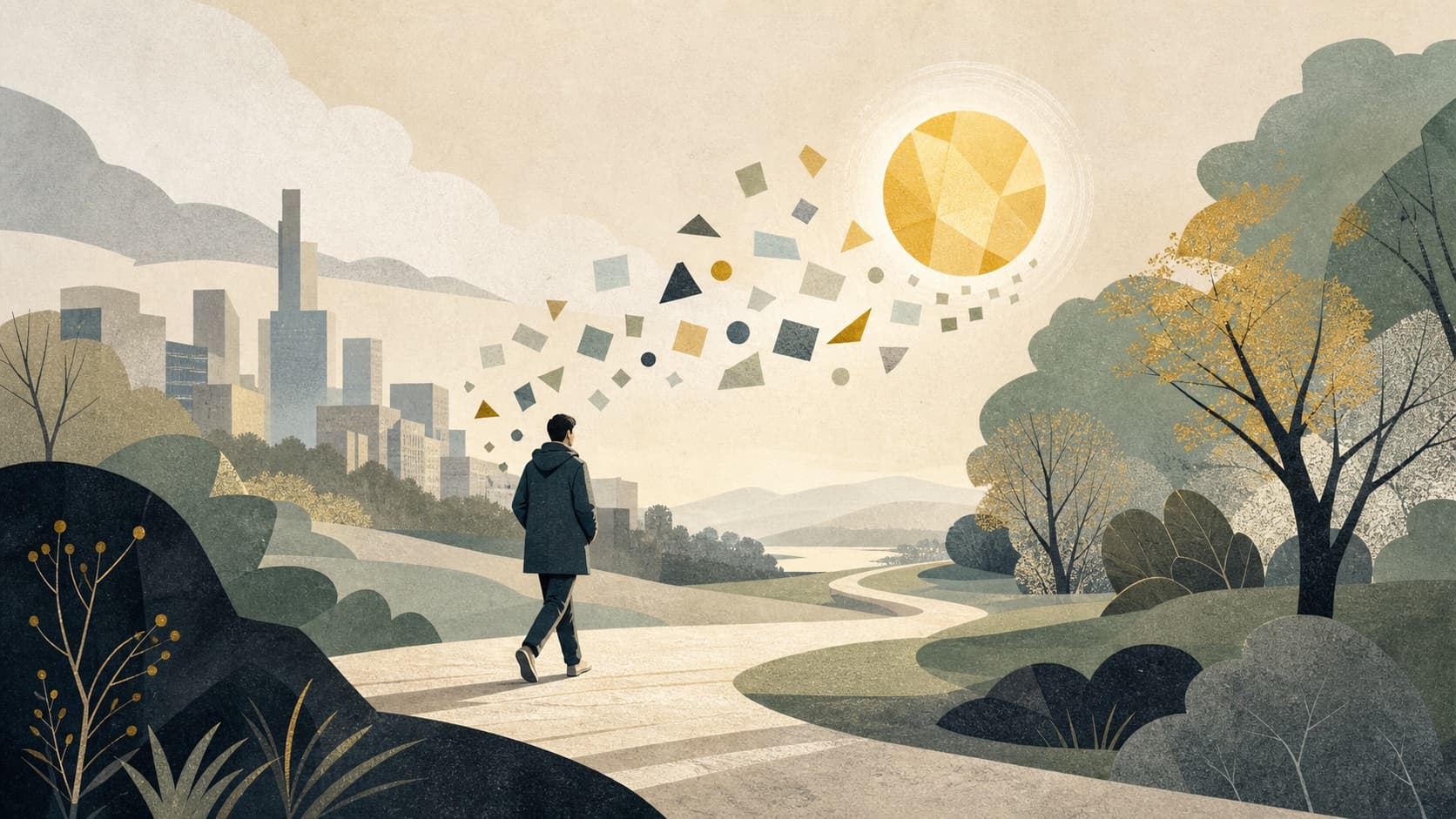
Some problems refuse to move while we stare at them. The document remains blank, the decision keeps circling, and every new attempt follows the same groove. Then we leave the desk, walk a few streets, and a useful sentence appears before the first turn home.
This can feel accidental, but walking reliably changes the conditions around thought. The body takes over a simple rhythm. The visual field widens. There is enough stimulation to loosen a rigid line of thinking, but not so much that it demands our full attention. We become occupied without being consumed.
A change of scene changes the question
At a desk, the problem and its evidence are fixed in front of us. That helps with precision, but it can also trap us inside the most obvious framing. Moving through a changing environment supplies gentle variation: a shop opening, a tree casting an unfamiliar shadow, a conversation heard only in passing. These details do not solve the problem directly. They interrupt the certainty that there is only one way to see it.
The effect is especially useful during early creative work, when the task is to generate possibilities rather than judge them. Editing still benefits from the desk. Discovery often benefits from leaving it.
Walk with one live question
A thinking walk works best with a light brief. Carry one question that is specific enough to guide attention and open enough to permit surprise. “How do I fix my career?” is too large. “What kind of work has made me lose track of time this year?” gives the mind something it can actually examine.
State the question before you leave, then stop forcing an answer. Let attention move between the surroundings and the problem. The aim is not to conduct a meeting in your head. It is to give useful associations room to form.
- Leave headphones behind for at least the first ten minutes.
- Choose a familiar route when the problem is complex and a new route when the thinking feels stale.
- Record ideas only when they feel worth interrupting the walk for.
Conversation improves on foot
Walking also changes how two people think together. Side-by-side movement removes the intensity of constant eye contact and replaces the formal turn-taking of a meeting with a shared pace. Silences feel less like failures because the walk continues carrying the moment forward.
This makes walking useful for exploratory conversations, mentoring, and decisions where the real issue has not yet been named. It is less useful when people need to review detailed evidence or take extensive notes. Match the medium to the stage of the problem.
Bring something back
A walk can create clarity and still produce nothing if the insight evaporates at the door. End with a small act of capture: a voice note, three sentences, or a sketch of the decision. Do not try to transcribe the entire experience. Preserve the part that changes what you will do next.
The walk is not an escape from work. It is a different room in which work can happen—one with moving walls, better air, and fewer buttons asking to be pressed.
A final thought
The next time a problem becomes motionless, resist the urge to add another tab. Take one question outside. Walk far enough for the desk to lose its authority, and return with a thought you could not reach while sitting still.
More from Ajay Gaur
Your Attention Is a Budget: Spend It Like One
A practical way to protect focus without turning your life into an optimization project.
How to Read Technical Documentation Without Getting Lost
Documentation becomes easier when you stop treating it like a book and start using it like a map.
The Case for Smaller, Better Side Projects
A constrained project can teach more, ship sooner, and remain alive longer than a grand unfinished plan.